
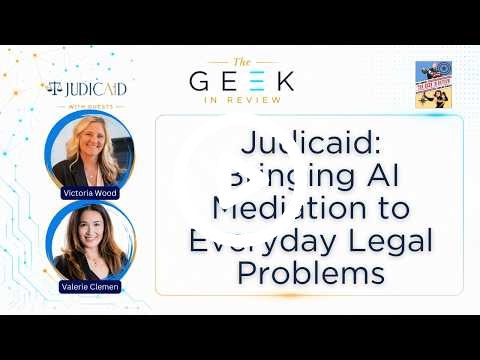
For millions of people, an everyday legal dispute never justifies the cost of a lawyer or a private mediator, no matter how much the outcome matters to them. Judge Victoria Wood saw that problem over and over during her years on the Napa County Superior Court bench. This week, Wood joins Judicaid Chief Strategy Officer Valerie Clemen to explain how those years led to Judicaid, an AI-assisted mediation platform built to help people resolve everyday disputes before time, expense, and emotion push them deeper into litigation.
Wood traces Judicaid’s origins to two problems she kept running into as a judge and mediator. Traditional settlement conferences arrive late in a case, after the parties have spent real money and dug into their positions. Then there are the lower-value landlord-tenant, contractor, neighbor, probate, and small-claims disputes where professional mediation rarely pencils out at all. Wood puts a number on the access problem. The State Bar of California’s 2024 Justice Gap Study, released in 2025, found that Californians received no legal help, or inadequate help, for 85 percent of their civil legal problems. Judicaid aims at a slice of that gap by giving people an earlier and cheaper chance to communicate and negotiate.
Clemen walks Greg Lambert and Marlene Gebauer through Judicaid’s “shuttle-style” mediation process. Each participant talks privately with an AI mediator named Jude, so the two sides never have to speak to each other directly. Jude gathers each side’s account of the dispute, identifies priorities and possible settlement terms, and moves between the participants while filtering out insults, anger, and inflammatory language. If the parties find common ground, the platform prepares a proposed settlement for review and electronic signature. Wood is careful about one boundary throughout the conversation. Jude is a facilitative mediator, and it stays away from evaluating legal rights. It will not decide who is legally correct, predict who will win, or give legal advice.
The conversation then turns to Judicaid’s pilot with Napa County Superior Court, and the role courts could play in expanding AI-assisted dispute resolution. In the court model, a court subscribes to the service and hands litigants’ access through a QR code, with no integration into the court’s technology systems. The pilot has already surfaced a behavioral lesson. Offering mediation as an optional service does not mean parties will use it, and Wood and Clemen see more potential where courts actively encourage or require litigants to attempt dispute resolution before proceeding. Language is another piece of the story, since Judicaid lets participants who speak different languages work through the same mediation without arranging multiple interpreters.
Wood and Clemen also see mediation as just the starting point. Wood uses the phrase “intelligent dispute resolution” for a broader category of AI-assisted tools covering mediator proposals, parent coordination, and other structured approaches to conflict. The bigger ambition is a change in habits, where people reach for structured communication and settlement before a disagreement hardens into a lawsuit. Clemen boils that aspiration down to three words she hopes become part of the vocabulary of everyday disputes: “Just Judicate it.”
Listen on mobile platforms: Apple Podcasts | Spotify | YouTube | Substack
[Special Thanks to Legal Technology Hub for their sponsoring this episode.]
Email: geekinreviewpodcast@gmail.com
Music: Jerry David DeCicca
LINKS
- Judicaid
https://judicaid.com/ - State Bar of California, California Justice Gap Study
https://www.calbar.ca.gov/about-us/data-reports/view-all/california-justice-gap-study - 2024 California Justice Gap Study
https://www.calbar.ca.gov/report/2024-justice-gap-study-report - Napa County Superior Court, Small Claims
https://www.napa.courts.ca.gov/divisions/small-claims
Transcript
Marlene Gebauer (00:00)
Hi, I’m Marlene Gebauer from The Geek in Review, and this week we’re talking with Judge Victoria Wood and Chief Strategy Officer Valerie Clemen from Judicaid. But first up, here’s a word from our great sponsor and partners at Legal Technology Hub.
Marlene Gebauer (00:13)
I have Sam Moore here from Legal Technology Hub. He’s going to tell us about AI governance from the advisory side.
Sam Moore (00:19)
Thank you. Good to see you again. Well, in the advisory team at Legal Tech Hub, we’ve been having a lot of conversations with clients about AI governance. Now, most law firms and departments have at least an AI policy of some kind, and there are some broad standards starting to emerge. A trend we’re seeing at the moment is a shift away from policies written in 2023 and 2024, which largely stated what you couldn’t do, and toward a more informative approach, which
Marlene Gebauer (00:37)
Okay.
Sam Moore (00:47)
defines different risk categories and
Marlene Gebauer (00:48)
You…
Sam Moore (00:49)
makes distinctions between routine, low-risk use of AI and other more substantial use cases. I think that’s appropriate for where we are, and it’s also what clients are coming to expect from their advisors. But one of the bigger challenges we’re seeing right now is how you express an AI use policy in such a way that any member of your legal team could explain it to a client. I think that’s still a big challenge for the industry.
Marlene Gebauer (00:55)
So, okay.
Sam Moore (01:17)
And I don’t think clients are all that happy if their attorney says, “I’ll have to get back to you about that,” because the attorney is probably using AI day-to-day. So they should be able to explain the policy themselves. How else do you know they’re complying with it? We’re doing some interesting work at the moment helping law firms and law departments take those first-version AI use policies that are very much “thou shalt not”
Marlene Gebauer (01:18)
So…
Sam Moore (01:43)
and turn them into more readable, appropriate governance positions that inform the conversation with clients. If anyone wants to find out more about our advisory services, they can find me or Cheryl Wilson Griffin on LinkedIn, or they can visit https://legaltechnologyhub.com.
Marlene Gebauer (02:01)
Thank you, Sam. I mean, it is really important to have AI policy in plain language so people understand it.
Sam Moore (02:07)
Absolutely.
Marlene Gebauer (02:15)
Welcome to The Geek in Review, the podcast focused on innovative and creative ideas in the legal industry. I’m Marlene Gebauer.
Greg Lambert (02:22)
And I’m Greg Lambert.
Marlene Gebauer (02:24)
Today we’re exploring whether artificial intelligence can help address one of the justice system’s most persistent problems, resolving everyday disputes without months of delay, escalating costs, or procedures that ordinary people struggle to navigate.
Greg Lambert (02:39)
Yeah, and to help us do that, our guests today are the Honorable Victoria Wood, a retired judge from Napa County Superior Court and founder and CEO of Judicaid. Joining Judge Wood is Valerie Clemen, Judicaid’s Chief Strategy Officer. Judicaid is an online, AI-assisted mediation platform designed to help people resolve disputes privately, affordably, and without first filing a case.
Marlene Gebauer (03:08)
Judge Wood and Valerie, welcome to The Geek in Review.
Valerie Clemen (03:12)
Thank you for having us.
Vickie Wood (03:12)
Thank you. Happy to be here.
Marlene Gebauer (03:16)
Judge Wood, Judicaid grew out of what you witnessed during your years on the bench in Napa County. What recurring problems convinced you that the traditional court and mediation systems were not adequately serving people with everyday disputes, and that technology could provide a better path?
Vickie Wood (03:34)
There were a few things. One of them, I’d say, is that I handled a lot of settlement conferences while I was sitting on the trial court bench, but usually those come very near trial, later in the case, when people are very entrenched.
Marlene Gebauer (03:50)
When the judge says, “You go in the other room and figure it out.”
Vickie Wood (03:54)
Yeah, yeah.
And they’ve already become very angered in their positions. They’ve already invested so much emotionally and financially, usually through attorneys’ fees, and it’s hard to get those settled. Sometimes that’s what it takes because people understand the dynamics and the finances, and they’re finally at their wits’ end and they’ll settle. But it comes at a cost. There may be families that could have had relationships saved if they could have talked earlier on and understood each other’s positions better.
So that’s one thing, the opportunity for earlier mediation or communication facilitation. For example, I handle a fair amount of probate disputes, and some people say probate disputes are essentially family law after someone dies. They’re highly emotional for lots of reasons that go back many years. But what very often happens is it seems like there’s a lot of money at stake, but by the time they go through the process and get to mediation, sometimes the entire amount is spent on fighting. And it’s really sad. People never thought that would be the case.
I often think to myself, boy, if I only could have been with these people earlier in the process and let them know what would likely happen if they continued down the litigation path. So that’s one of the things that inspired it. The other thing is that there is this broad swath of disputes that are lower value and really don’t justify the expense of resources for attorney representation or human mediators. But those disputes still mean a lot to people, even though they’re low-dollar-value. In fact, that’s the reason why I decided to go to law school, being in a very low-dollar-value dispute with a landlord who I felt had done us wrong, and I was gonna
Greg Lambert (05:56)
Ha ha.
Vickie Wood (05:57)
fight it. And we did sort of win, but boy, it took a lot of time.
But these cases mean a lot to people, and they don’t have the same access to alternative dispute resolution as higher-value cases. So that was the other problem I was looking to fix. In fact, there is a State Bar of California justice gap study that was recently released. It was a follow-up study from 2019, then redone in 2024, with those results coming out in 2025. They reflect, let me get this right, that Californians receive no legal help or inadequate legal help for 85% of their disputes.
And I thought that was astonishing.
Marlene Gebauer (06:59)
I wish I thought it was astonishing. It’s like, I…
Greg Lambert (06:59)
Yeah. Yeah. And…
Marlene Gebauer (07:03)
I think…
Greg Lambert (07:03)
I don’t think Californians are unique in this either.
Marlene Gebauer (07:06)
No, no.
Vickie Wood (07:07)
Yeah. So this was a California study, obviously, but that’s 85% of disputes where people don’t have help, don’t have adequate help, or they throw their arms up and say, “The justice system can’t help me.”
After the 2019 study, the California Judicial Council really made efforts to try to close this justice gap. The problem was that the results from 2024 showed things got worse, not better, despite their efforts. So that was striking to me as well.
When I left the bench and started my mediation practice and started studying and using AI, it came to me that there is probably a portion of these cases that could benefit from what AI and LLM technology can do. That’s how Judicaid was born. I came up with the idea and the name, and then I happened to have a family member who is brilliant in the tech world. I mentioned it to him and he said, “I can build that for you.” And he said, “That will be easy.”
So, more than a year later…
Greg Lambert (08:27)
Yeah, I imagine in California…
Marlene Gebauer (08:28)
Words you like…
Greg Lambert (08:29)
Yeah. Well, it’s nice…
Marlene Gebauer (08:29)
to hear when you’re building tech, “It will be easy.”
Vickie Wood (08:32)
Yeah, yeah. “That’d be easy.”
Greg Lambert (08:33)
to be in California where you can’t swing a cat without hitting an engineer.
Vickie Wood (08:39)
Yeah, needless to say, it was not easy. It proved to be much more challenging, but he and the other part of the tech team did it. We’re really proud of the tech product, the rest of our product, and the platform, and excited to be getting it out in the world. So thank you for the opportunity to be here today.
Greg Lambert (09:00)
So, Valerie, I want to jump into what Judicaid does and how it’s set up. But let’s start off with the user experience. Let’s take a typical user of the system, maybe two people having a landlord-tenant, contractor, or small-claims dispute.
What happens from the moment one person opens a matter on Judicaid until the parties either reach a settlement or determine that the mediation won’t resolve it? Can you walk us through the process of Judicaid?
Valerie Clemen (09:37)
Sure. The product just went live, I want to say, like six weeks ago. There are actually two aspects to it. There’s the consumer-facing version, where people can go on, pay $34.99, and start a mediation. But we also have the court-subscription version. Napa Superior Court currently has a pilot in its small-claims cases, so it’s a little different depending on which one we’re talking about.
Essentially, it’s a website, a standalone website. Parties can go there, create their own account, and put in some basic information about who the other side is and what the dispute is about. They never speak directly with the party they’re having a dispute with. An email goes to the other side and says, “We’re sorry you’re in a dispute. The other side would like to try to work this out with you. Please sign up as well.”
Hopefully they sign up if they’re willing to talk. Once they sign up, there’s literally an AI mediator that first goes to the initial party and goes back and forth asking questions like: When did this happen? What occurred? What is owed? Usually it’s over money or property. What attempts have there been to resolve it? What do you want today to resolve it? Once it has this information, it says, “Sit tight,” and then it goes to the other side.
When it says “sit tight,” people can be doing this on their phone, laptop, or tablet, and they don’t have to be online at the same time. It basically sends a message to each side when it’s their turn to speak to the AI mediator. It’s essentially the LLM, the AI engine, asking the questions and doing this.
So it goes to the other side and asks the same kinds of questions. What’s your version of the dispute? How do you feel about it? What’s your bottom line? What do you want? Once it has that, it starts going back and forth and tries to ask questions, get more information, and bring both sides to an agreement, hopefully in the end. It’ll keep going back and forth as long as it takes.
We’ve done a lot of pressure testing. Vickie and I are both attorneys, so we were like, what would a litigant say if you’re really upset? They might tell the AI mediator to F off and say, “You’re an idiot,” or whatever. So we did all of these things, and it’s great. It’ll hear these things and say, “I understand you’re upset, but what is your bottom line?” It’ll never go to the other side and say that this side insulted you. It’s very good at filtering
Marlene Gebauer (12:16)
Yeah.
Valerie Clemen (12:17)
and focusing on the problem and how to resolve it. Once it senses there’s an agreement, maybe there’s a payment plan worked out, it’ll prepare a draft agreement and send it to both sides and say, “Could you live with this? Is this what you want? Is this the agreement you want?” If both sides say yes, it creates an agreement, sends it to both sides through DocuSign, and you have a signed settlement agreement.
Greg Lambert (12:43)
Okay. Well, let me jump in on one question. What incentive does the counterparty have? I can see an incentive where I want to pay the $35 to get the subscription, but what’s the incentive on the other side to join this mediation?
Valerie Clemen (13:08)
Usually there’s a threat of a lawsuit. Like, “I’m gonna take you to small claims. I’m gonna call the Contractors State License Board.” If it’s a home-improvement project, there’s some threat because someone’s upset and wants something. So either you resolve it with that person or they’re gonna take the next step, which could have professional consequences. You might have to deal with litigation. You’re gonna be sued. In the world of Google, if you get sued by someone, somebody Googles your name and that shows up forever.
So the ability to resolve something before it turns into something worse would hopefully be motivation. But, you know, humanity…
Vickie Wood (13:46)
Yeah, but Greg, you ask a really good question because that is a sticking point. The platform generates an automatic email invite to the other side, and it says this person has either filed a lawsuit or is considering filing a lawsuit, but they would like to first try to resolve this peacefully.
You don’t lose any of your rights if you’re not able to resolve it. I personally would be very motivated to try that, knowing what it’s about, but what we’re finding is that a lot of people don’t even know exactly what mediation is, and they don’t know what they’re getting into. We try to highlight that this is completely confidential. The court’s never gonna know anything that is said. You preserve all your rights.
But that is a tricky part of this, and we’re hoping that if it gets out there and becomes more normalized, that’ll take away some of that reluctance. On the other side of the coin, I think people in general would really like to avoid going to court, seeing this person face to face, and talking to a judge. These are scary things. People are getting less used to talking to people face to face, so we’re hoping it’s going to play into the natural progression of how people would rather address conflict.
Marlene Gebauer (15:18)
So I’m curious about how the AI is trained. I’m assuming that it trains on contract law, landlord-tenant law, things that would come up as part of these disputes. I’m also curious, we talk about personas here sometimes in terms of different types of training and things like that. I’m wondering if judge personas were part of the training.
And then how do you keep the system from crossing the line into giving legal advice? I heard a little bit, if we sense there’s an agreement, we’ll start with the decision, but how do you avoid legal advice or saying, okay, right, wrong?
Vickie Wood (16:03)
Mm-hmm. Great questions. First off, no, it’s not trained in the law.
It doesn’t give any legal advice whatsoever. It is essentially a facilitator of the communications. As a mediator, most mediators know there’s a spectrum of how you approach mediation. You can be on one end, mostly facilitative, where you’re exploring people’s values and priorities in trying to get the case resolved, and you’re facilitating communication about how they feel and their thoughts on the case.
On the other end of the spectrum is a mediator who becomes quite evaluative and says to someone, “You’re gonna lose this case,” or, you know, “Here’s…”
Marlene Gebauer (16:48)
You know, “You might want to think about this.”
Greg Lambert (16:50)
Mm-hmm.
Vickie Wood (16:52)
“This is where I’m really concerned. These are your risks.” Generally, at least in how I mediate, and I think it’s one of the better ways to approach mediation, you start out facilitative and then, as the day goes on, you can get a little more evaluative and try to push things toward that end.
Judicaid stays facilitative. So there’s no legal advice. It’s not trying to tell someone, “You’re gonna lose this case,” or, “They’re right on this point and you’re wrong,” or vice versa. It will remind them of the risk and hassle, the time and expense of going to court, and the risk that they may not win their case, encouraging them to continue to think about compromise and keep engaging so they inch their way toward a palatable compromise where eventually they go, “Okay, I can say yes to this and be done and not have to deal with court.”
So that’s the idea, and that’s why we’re able to offer it nationally, because it doesn’t deal with laws that would be individualized to each state.
The training aspect is really, there are two main tech pieces. There’s the application that’s coded, which is our AI engine for the shuttle-style back and forth. That took a really long time to create. Then there is the mediator disposition architecture, and that’s where I had a lot of input as the subject-matter expert. It’s like a 38-page prompt that…
Marlene Gebauer (18:42)
Ha ha ha.
Vickie Wood (18:42)
That…
Greg Lambert (18:42)
How?
Vickie Wood (18:43)
guides Jude, our mediator’s name is Jude, by the way. It tells Jude…
Marlene Gebauer (18:48)
Do you say, “Hey Jude,” when you talk to it?
Vickie Wood (18:51)
Jude. We actually…
Marlene Gebauer (18:53)
I’ll leave now.
Vickie Wood (18:54)
never intended to have a name, and it just sort of came about. Since it’s Judicaid, and Jude’s sort of a gender-neutral name, we thought, why not? We’ll go for it.
But it’s the disposition, sort of prompting architecture, that tells it how to respond and how to continue to inch people toward a compromise. There are lots of guardrails so it’s never giving legal advice. It can suggest, if someone says, “Do you have any ideas on how we might be able to resolve this?” it can say, “Well, one thing you might consider is this,” or, “You could take payments over time,” or, “Maybe take a smaller payment up front and then the balance over time.” It can suggest things like that, but it’s very generalized in that way.
That’s a big part of why it was never intended to replace attorneys or human mediators. As a mediator, I know that most complex cases that go to human mediation are far too complex, both legally and emotionally, for an LLM to manage. So this is not trying to replace that. This is focused on filling the gap for those lower-value cases that are generally fairly simple.
There is emotion involved, and that’s something an LLM is very good at managing in communication. It’ll calm the person down, and they can get as upset as they want. It can be empathetic and say, “I hear you’re feeling really frustrated about that, and that’s understandable. But why don’t you let me go talk to the other person?” It’ll go to the other side, and it’s never gonna convey the anger or the bad words being said in the other room. It’s gonna say, “They’re feeling concerned about this.” So it paraphrases things in a way that makes them far more palatable to hear when you’re the adversary.
That’s a big part of what I do as a human mediator. When somebody is cussing and swearing and saying horrible things about the other side, I go in the other room and say, “Yeah, well, they’re starting to come around.” So…
Greg Lambert (21:17)
Yeah, I was gonna say, do you have it default back to those instructions so it doesn’t get caught up in what each side is feeding it, but rather goes back to its baseline to make sure it stays on the course it needs to stay on?
Vickie Wood (21:40)
Yeah. Like I said, the prompting architecture is vast, and it’s very carefully thought out in phases to guide things through. But it has priorities around guardrails, and if there’s any sort of safety issue, somebody says, “This is terrible. I’m gonna kill myself,” we make sure it’s gonna say, “If you’re struggling with that, then you need to consult resources in your locality. This may not be the place to do this.”
And there’s a button to say, “Stop mediating,” and terminate the mediation at any point in time. So, yeah, a lot of thought went into that…
Marlene Gebauer (22:25)
I have one. I have one.
Vickie Wood (22:27)
Aspect.
Marlene Gebauer (22:29)
Does it learn? I mean, from session to session or are those isolated?
Vickie Wood (22:34)
They’re isolated. We have made the decision at this point that we’re not training the AI model directly in the way that an open-source LLM would be constantly training itself.
Yeah, it’s truly intended to be confidential, just like mediation is confidential. You’re not supposed to go tell a court, “Well, in mediation she said this or that,” or you’re not allowed to, at least in California.
Greg Lambert (23:03)
And that’s when you hold up your hand saying, “I don’t want to hear that. I don’t…”
Vickie Wood (23:06)
Yeah. Yep. Exactly.
Marlene Gebauer (23:08)
No, no.
Vickie Wood (23:09)
Exactly. Privileged. So…
Greg Lambert (23:12)
Well, we talked about the user side, so let’s go over and talk about the court side. Courts appear to be a really important path for Judicaid going forward. Valerie, I’ll start with you, and Judge Wood, if you want to jump in, please do. What would a court-facing model look like in practice, and where do you see it fitting into the life cycle of these disputes?
Is it before the case is filed? Is it after, but before a hearing? Is there someplace else? Where do you see the path of leveraging either the threat of the court or the actions of the court to help Judicaid?
Valerie Clemen (23:55)
Yeah. Initially, it would be good to have it in self-help centers, because a lot of times, especially for small claims, landlord-tenant, or those types of claims, those parties are unrepresented. You just can’t afford to pay an attorney’s hourly rate for a case that’s honestly below $20,000. It doesn’t make any sense to pay an attorney, so they’re trying to figure out the system themselves.
Knowing they have this option to resolve their dispute without going through the paperwork, getting it served, and filing is helpful. So having that information in self-help centers and in the courts pre-filing is helpful. Once a case is filed, it would be helpful for courts to provide that option and, honestly, not make it voluntary. Make it mandatory to give it a try, to talk to the other side using some type of dispute resolution or mediation, but also provide Judicaid as a free resource for litigants to use and try to resolve the dispute.
The information would come at the time of filing. Like, here’s your complaint, you have to serve the other side, and also serve the other side with this dispute-resolution information to see if you can resolve the case before your hearing date comes up. In some courts, when your hearing date is set out six months or a year, being able to resolve it and put the thing behind you before that happens, or before you spend money having the sheriff personally serve it or hiring a process server, is helpful. There are so many costs and so much time associated with litigation.
The hope is that letting litigants know there’s this option would be helpful. Of course, a lot of unrepresented litigants are doing this for the first time. They’ve never filed a small-claims suit. They’ve never been in a legal dispute. A lot of them probably don’t even know what mediation is. I’d say at least 10% get the flyer and are like, “Meditation? I know I’m angry, but I don’t need that.”
Marlene Gebauer (25:48)
Yeah.
Valerie Clemen (25:49)
Like, just not having any idea.
Vickie Wood (25:51)
It should go hand in hand, though.
Greg Lambert (25:51)
I need it, but not in this case.
Valerie Clemen (25:54)
Yeah. Because honestly…
Greg Lambert (25:57)
So are you educating law librarians and self-help centers on this, so they have it as a tool they can point people to as an alternative, or…?
Vickie Wood (26:11)
We’re trying to. We’re trying to. We just…
Marlene Gebauer (26:15)
That’s why they’re on the podcast, Greg.
Vickie Wood (26:18)
But yeah, in Napa County, where we’re running the pilot, we have definitely put it out there to all of the people who might be interested. We’ve got flyers in the law library and in the regular county library. While it’s being offered for free, government agencies have a line where they don’t want to be advertising something that’s for profit.
But while they’re piloting it, or if they were, and actually, let me jump back to one of your questions, Greg, about what this would look like through the court. The platform itself will be identical. The courts would pay for a monthly subscription, and then they would be given a QR code that they could provide to litigants upon filing. They could even put it on their website, in the small-claims area, for people who are thinking of filing a claim to try it before they file.
Those people would enter the site through a landing page for that court with that QR code. There’s a little gateway where they have to say how they got there. If they didn’t get there through that court, we’re going to redirect them to the paid portion. But if they got there through the court through the QR code appropriately, then they bypass the payment piece and jump into the platform exactly the way everybody else does.
So, yeah, we’re trying to get this out there. We’re on social media. We just got back from a national court conference in Delaware. We were having conversations with courts across the U.S., getting them aware. I think the trick in trying to get courts on board with this is that most of the technology out there needs to be integrated into the courts’ networks and processes.
Their first thought, I think, is, “Here’s yet another AI-based app or process that we’re gonna have to implement and then be tied to this company for however long, and tied to their schedule of upgrades and new features and their pricing changes and all of that.” We’re completely different from that. The only thing the court has to do is give that QR code to its litigants or potential litigants, and any questions go through our support page. That’s it. That is it.
I think courts are having a hard time comprehending that it could be that easy. Hopefully we’ll get the message out. What was that, Marlene?
Marlene Gebauer (29:01)
This could be very helpful for them.
Greg Lambert (29:02)
Yeah.
Marlene Gebauer (29:05)
It could be very helpful for them in terms of the docket. So…
Vickie Wood (29:11)
Yeah, that’s the idea. And it’s so affordable that it’s sort of a win-win-win proposition, and it feels like a no-brainer to us. But still, it’s gonna take some time to get people to first be aware of it and then have a true understanding of how simple it is.
Valerie Clemen (29:29)
Yeah. I’ve had clients come to me, we’re in a small town, so I have clients who come to me with certain issues, and sometimes they come with things that are just so minor. They have a dispute with their neighbor and the money involved is so low, and I’m like, “Look, I can’t honestly have you pay me for this, but try this.” I’ve had a couple of clients go try Judicaid, and they were like, “It was easy to sign up and send the invite, but the other side didn’t respond.”
But it was nice. Sometimes clients come to you and they have things that are too minor, and you’re like, “Look, the budget for this doesn’t make sense.” Giving them something, some tool where they might resolve it on their own, was nice instead of saying, “I can’t take this. Good luck.”
Vickie Wood (30:12)
Yeah. So that is another sort of distribution channel, if you will. Exactly what Valerie just said, for attorneys to be able to give something of value to those clients they have to turn away. Say, “There’s another tool here.” We think it’s something attorneys would really like having in their back pocket for that situation. The problem is there is that immediate reaction of, “What is this taking? Is this going to take away our business?” Or, for…
Greg Lambert (30:45)
Yeah.
Vickie Wood (30:45)
mediators, “Is this going to take away our business?”
And I’m saying, no, it’s not that. LLMs are obviously changing the legal scene drastically, but at this level of sophistication, they can’t replace humans. You absolutely need human mediators. So hopefully, if there are attorneys out there listening, this is something for you to have to give to the people who you can’t otherwise help.
Valerie Clemen (31:16)
Yeah. It’s like…
Marlene Gebauer (31:16)
Yeah, I’m kind of looking at it like it’s an initial step because you’re absolutely right. I was very curious, a human mediator can sense when there’s unequal bargaining power or someone’s more legally sophisticated, and they can run their mediation with that in mind. But I’m curious how Judicaid does that as a technology tool.
Vickie Wood (31:43)
Well, in some ways it’s more neutral. Because it’s just going to be kind of…
Marlene Gebauer (31:47)
Yeah. It’s neutral. That’s it.
Vickie Wood (31:54)
Yeah, yeah. It’s not gonna be impressed by the person who is sort of a bully or sounds like they really know what they’re talking about. It’s not gonna be more persuaded by this side or that side. Again, it’s facilitating that conversation in a really neutral way.
And to your point about it being a starting point, yes, I do think cases will get resolved through this. But if they don’t, I also think there’s another value that goes beyond monetary. Let’s talk about this, it isn’t limited to small claims. It could be used for limited civil cases. It could be used for eviction cases. We’re gonna add a feature to try to get this into family law for parent-coordination kinds of things. I have unlimited features in my head, so it’s just a question of getting them to happen.
What I would see with small claims is, like I said in the beginning, people are passionate about these cases and they spend days’ worth of time preparing for them and putting everything into them. Then they get to court and there are 40 cases on the docket for trials. They’re gonna sit there for a long time, their case gets called, and they get maybe 10 minutes. And…
Greg Lambert (33:13)
Yeah.
Vickie Wood (33:14)
even if they win, but especially if they lose, they walk away not feeling good about the process and about the justice system, because many times this is these people’s only real interface with the courts. They walk away not feeling good about it, and that’s not good for any of us. That’s not good for society in general.
So if they start with a product like Judicaid, where they’re able to kind of be “heard,” and I’m putting that in air quotes for anyone who’s only on audio, to air their feelings about it and also hear the other side’s position and thoughts, and then have to think through the potential outcome that it may not go their way and decide they want to take that risk, well, now they’ve had much more participation in the ultimate outcome. I feel like that’s going to be an improvement for everybody across the board.
Greg Lambert (34:12)
Yeah. Well, I want to touch on your pilot with the Napa County Superior Court. Tell us about what you’re piloting. Beyond finding out whether the technology works, what are you hoping the courts will find out, and what are you hoping to find out from this pilot on your side?
Vickie Wood (34:35)
Yeah, so we’re new with the pilot. We’re kind of just starting to get through the period from where we started to where cases would be coming on to trial. We have had people engaging, but we’re not getting the mediations to happen yet.
So we’ve learned one really important thing, which is that people are gonna be reluctant to do this right now if it’s purely voluntary. That was a very valuable thing to learn. We knew there would be reluctance, but there’s significant reluctance.
One note, though, is that Napa County is a tiny county, so the number of filings is a very small sample to be working off of.
Greg Lambert (35:18)
I’m envisioning the mediation being over a glass of wine. That’s all I see.
Vickie Wood (35:22)
Of course, Greg, of course.
Marlene Gebauer (35:22)
Ha ha.
Vickie Wood (35:25)
If they’re not drinking wine, then the dispute is about wine somehow. But yeah…
Greg Lambert (35:30)
Yes.
Vickie Wood (35:32)
It’s a small county. But yeah, once we start getting engagement, and we’re connecting with some larger counties, one in particular is a large county that already mandates mediation for both small claims and unlawful detainers. They offer some human mediation options that are lower-cost than most human mediation, but still significantly more than Judicaid. So this would be another thing to offer people.
One of the greatest features about Judicaid is that it can be done in many different languages. You can have somebody who speaks only Spanish and someone who speaks only Russian mediating together. That would be very expensive to provide with a human mediator because you would probably have to have two interpreters for one mediator, and the cost skyrockets.
So, yeah, we’re hoping to get a bigger sample, especially one where it’s mandated, because we think if it’s mandated, a lot of people will opt for this because it’s so easy. You don’t have to schedule a set time. You can do it literally over your phone, dictating.
Greg Lambert (36:47)
And you mentioned that this isn’t just California, right? You’re looking at going…
Vickie Wood (36:51)
Correct.
Greg Lambert (36:54)
going into other states as well.
Vickie Wood (36:56)
Correct, correct. Yeah. And maybe, I mean, honestly, I don’t know why it couldn’t go outside the U.S. too, because again, it’s not tied to any particular laws. So I don’t know. I don’t want to think too big just yet, but…
Greg Lambert (37:09)
Well, then you have to deal with the EU and GDPR and all that, so, you know…
Valerie Clemen (37:14)
Yeah, yeah.
Vickie Wood (37:15)
Yeah. Well, I’ve been really bored lately, Greg. That would give me something to do with…
Greg Lambert (37:19)
Yeah.
Vickie Wood (37:19)
my time.
Marlene Gebauer (37:19)
Yeah.
So we kind of close the podcast by looking back and then looking forward. This is kind of our “what’s different now” question. If we had spoken with you a year ago, other than the fact that maybe Judicaid didn’t exist, what would you have told us is materially different today? What have users and court partners, or the experience of building the platform, taught you that changed your original assumptions?
Vickie Wood (37:56)
When I conceived of it, which was closer to two years ago, the way ChatGPT or any of these large language model platforms functioned was astonishing. I mean, it still is astonishing, but more people were seeing it for the first time or had not seen it yet. So the concept of what Judicaid does was almost like magic. Now people are aware that having a computer talk to you like it’s a human can be done.
What we have, that I don’t think is done anywhere else, is this shuttle-style approach where it’s truly exchanging the communications. But when my CTO told me, “This will be easy,” I thought we would be launching in like two months. Then all these months later, it’s not quite as novel as it was at the time.
At the same time, there’s also a fair amount of skepticism of AI and concern about AI taking jobs. There are people who might see that it’s an AI-facilitated platform and want nothing to do with it, without considering that this is something trying to provide a positive benefit and fill a gap. Those were unexpected things, but we’re rolling with it because I think it’s gonna require a little bit of awareness about what we’re doing.
Also, AI is becoming so pervasive that I think eventually people are…
Greg Lambert (39:41)
Yeah.
Vickie Wood (39:42)
just gonna get tired of being so against it, I guess. But yeah, I think the other thing is we focused on mediation because that’s the piece we wanted to nail down. Now that we have that core AI engine, we can branch off in so many different dispute-resolution ways, which gets me so excited.
We’re now calling it intelligent dispute resolution because it may not just be mediation. We might start having mediator’s proposals. We might have a parent coordinator to help with little custody disputes.
ODR, online dispute resolution, has been around for quite some time, but I think intelligent dispute resolution is new. So I’m gonna say you heard it here first.
Greg Lambert (40:29)
All right, all right. Well, that leads in perfectly to our crystal ball question. Valerie, I’ll let you start this off if you don’t mind. So…
Valerie Clemen (40:38)
Sure.
Greg Lambert (40:39)
Picking up on Judge Wood’s discussion there about intelligent dispute resolution, in three to five years, where do you see things when it comes to AI-assisted dispute resolution? What’s it gonna look like, and what all do you think it will cover?
Valerie Clemen (40:58)
I mean, our hope is that it would be offered in courts nationwide, because this underserved population doesn’t have access to dispute resolution or mediation, and this would provide that. So we would like to see it used in courts nationwide.
I would also, I mean, this is hopeful, but it would be nice if people just thought to “Judicate it”…
Vickie Wood (41:19)
Yeah.
Valerie Clemen (41:19)
when they have disputes, to go there first. You see people arguing on Nextdoor. Sometimes you think we should have guerrilla marketing and just go in there and say, “Just Judicate it.” Like, there’s so many…
Vickie Wood (41:32)
I don’t know if Nextdoor is national, but it’s this neighborhood platform. And yeah, so…
Greg Lambert (41:35)
It is. You know. No, we all…
Valerie Clemen (41:36)
It is.
Greg Lambert (41:38)
know. “Was that fireworks or gunshots?” is the most popular…
Valerie Clemen (41:41)
Yes, exactly. Exactly. “Does anyone…”
Vickie Wood (41:46)
Yeah.
Valerie Clemen (41:44)
“recognize this car?”
Greg Lambert (41:46)
Ha ha.
Valerie Clemen (41:47)
But people have disputes, and it’s really hard to get people talking to each other. Oftentimes, when people start talking to each other, they resolve things. It’s that initial step, because it’s uncomfortable, it’s adversarial. But once people do it, they can often resolve a lot of issues.
So the idea that people could use this as a tool to help get things started, it’s really hard to walk up to someone…
Marlene Gebauer (42:12)
Okay.
Valerie Clemen (42:13)
and confront them and talk about something, even if you have it simmering. I mean, people have a hard time with that with family members. You’ve had this thing simmering forever, but you can’t address it.
This is a tool that helps you be a little protected but still share your thoughts and feelings and resolve disputes. The idea that people could use it for all kinds of disputes, I mean, it is a very civil way to resolve disputes and quash things, and not have things linger for a long time.
But obviously, in the legal sense, it would be nice when people do have disputes to the level where they’re ready to file a lawsuit or do something more, that they have a way to either solve it beforehand or try to solve it once the lawsuit has started. They don’t have attorneys helping them in a lot of these cases. They’re probably using Claude or ChatGPT to help them with their case. So this is another resource to help them resolve it instead of keep fighting.
Vickie Wood (43:09)
Yeah, or have it escalate to something more than it ever needed to be. And just to tack on to that, I think that’s exactly right. A lot of times it’s barriers to communication, and that’s what Judicaid is trying to resolve. Whether it’s lack of skill with communication, a power dynamic, or a language barrier, that’s really where Judicaid provides this platform at a very base level.
And hopefully, this is my tagline that I have in our little video, my hope is someday that instead of saying, “Let’s take it to court,” we’ll say, “Let’s just Judicate it” instead. So that’s our hope.
Marlene Gebauer (43:49)
I like it. I like it.
Well, Judge Wood and Valerie Clemen, thank you for joining us and giving us a closer look at Judicaid, at both the opportunities and difficult questions that come with using AI and expanding access to dispute resolution. And thanks to all of you for listening to The Geek in Review. If you enjoyed the show, please share it with a colleague. We’d also love to hear from you on LinkedIn and Substack.
Greg Lambert (44:17)
And Judge Wood and Valerie, where can listeners go and find out more about Judicaid?
Vickie Wood (44:26)
Judicaid.com. We have a lot of information on there, including an instructional video that’s on YouTube, but you can access it from the homepage, along with how-to instructions. We’re on Instagram, Facebook, X, and LinkedIn, but that’s probably the best place to start.
Greg Lambert (44:47)
Soon to be on Nextdoor.
Marlene Gebauer (44:48)
All the places.
Valerie Clemen (44:50)
Yeah.
Vickie Wood (44:51)
I actually am on Nextdoor. That’s true. I haven’t really spent a lot of time on there yet, but yeah…
Marlene Gebauer (44:55)
Ha.
Vickie Wood (44:56)
I’m going there, Greg.
Greg Lambert (44:59)
Awesome, awesome.
Vickie Wood (45:00)
Thank you so much.
Marlene Gebauer (45:02)
And as always, the music you hear is from Jerry David DeCicca. Thank you, Jerry. Goodbye, everybody.