3 Geeks and A Law Blog

A law blog addressing the foci of 3 intrepid law geeks, specializing in their respective fields of knowledge management, internet marketing and library sciences, melding together to form the Dynamic Trio.

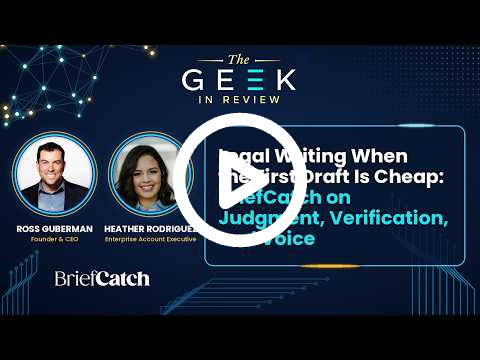
This week we talk with Ross Guberman, founder and CEO of BriefCatch, and Heather Rodriguez, the company’s enterprise account executive. Ross built BriefCatch to put the lessons from his books and workshops in front of lawyers while they write. It started as a rules engine that flagged everything from typos to sentence flow. He admits he was…
Continue Reading Legal Writing When the First Draft Is Cheap: Ross Guberman and Heather Rodriguez of BriefCatch


Law firms and legal departments face pressure to adopt AI, yet buying another tool does not answer the hardest question: Which problem needs solving? Dr. Maryam Salehijam, founder and CEO of Andarzi, joins TGIR hosts, Greg Lambert and Marlene Gebauer, to discuss how legal teams choose between existing systems, new vendors, and tools built for their own workflows.
Continue Reading Legal AI Strategy Beyond the Prompt: Maryam Salehijam on Adoption, ROI, and Building What Works

What happened when I pointed Jev, SALI, and CLOC’s Core 12 at every post we’ve ever writtenI read Nate Jones’s post on Jev, TypeSafe’s new “System One” model, and he described it as an LLM that can only talk in multiple choice. It reads what you give it, you hand it the possible answers, and it picks one and…
Continue Reading Teaching a Multiple-Choice Machine to Read 18 Years of 3 Geeks

Paul Lee, co-founder and CEO of Patlytics, joins Greg Lambert to explain how an AI platform built specifically for intellectual property work is changing the patent lifecycle. Patlytics supports workflows spanning patent drafting, prior art analysis, office action responses, portfolio management, litigation readiness, and claim-chart preparation. Lee reports that the company now works with roughly 55 percent of…
Continue Reading Patlytics and the Patent AI Race: Paul Lee on USPTO Workflows, Human Judgment, and the AI Dividend

What happens when you separate elite legal talent from the traditional law firm structure? This week on The Geek in Review, we talk with Manuel Deó, co-founder and co-CEO of Ambar Partners, about a model designed around senior independent lawyers, flexible capacity, enterprise technology, and client choice. Deó explains why he and co-founder Rosa Espín did not set…
Continue Reading Beyond the Law Firm Pyramid: Manuel Deó on Ambar, Fractional Legal Talent, and the Future of Legal Delivery

For millions of people, an everyday legal dispute never justifies the cost of a lawyer or a private mediator, no matter how much the outcome matters to them. Judge Victoria Wood saw that problem over and over during her years on the Napa County Superior Court bench. This week, Wood joins Judicaid Chief Strategy Officer Valerie Clemen to explain how…
Continue Reading Judicaid: Bringing AI Mediation to Everyday Legal Problems

What happens when a 40-year-old legal data company decides its employees should start building their own software? This week on we talk with Best Lawyers CEO Phillip Greer and Senior Vice President of Research and Product Strategy Elizabeth Petit about an internal AI transformation that reaches far beyond adding ChatGPT to the corporate toolkit. Best Lawyers is experimenting with generative…
Continue Reading From Search Rankings to Vibe Coding: How Best Lawyers Is Rebuilding for the AI Era

In this episode of The Geek in Review, we talk with Patrick Forquer, Chief Revenue Officer at Legora, about legal AI’s move from experimentation into daily legal work. Forquer explains why Legora has invested heavily in legal engineers, lawyers with practice experience who work alongside clients on adoption, workflow design, prompt and context engineering, and change management. The…
Continue Reading Patrick Forquer on Legora’s Agentic AI, Legal Engineering, and Consumption-Based Pricing

It turns out that tech companies don’t sit outside of government as just ordinary vendors. This week on The Geek in Review podcast, we welcome back Texas A&M University School of Law professor Hannah Bloch-Wehba to talk about accountability of Big Tech, AI regulations, government surveillance, and the intertwining of public authority and private tech infrastructure. Bloch-Wehba traced the dependency…
Continue Reading Who Governs Big Tech? Hannah Bloch-Wehba on AI Regulation, Police Surveillance, and Public Accountability

We welcome back Brad Blickstein, CEO at Blickstein Group, to discuss how private equity principles may provide law firms with an alternative approach to profitability, governance, and even long-term growth. Blickstein’s new book, WWPED: What Would Private Equity Do? was written to walk firms through how treating topics like pricing, technology, talent, and client relationships as part of…
Continue Reading Brad Blickstein on Private Equity Thinking, AI Pricing, and the Law Firm Business Model

Fresh from AALL in Cleveland, Greg reflects on a conference filled with legal information professionals who understand how technology performs under real working conditions. These librarians purchase products, train users, support law schools and courts, and often serve as internal advocates for legal technology. Their expertise makes vendor engagement especially valuable, yet major product announcements were scarce. Marlene balances Greg’s…
Continue Reading From AI Personas to Rogue Agents: Rethinking Legal Training, Security, and Value

In this episode of The Geek in Review, Greg Lambert hosts a solo conversation with Triona Buckley, Chief Product Officer at Actionstep, about generative AI’s growing influence on mid-market law firms. Buckley challenges a common assumption about legal AI: faster task completion does not always remove friction. An associate might produce a draft within seconds, only to transfer…
Continue Reading AI Is Shifting the Bottleneck: Actionstep’s Triona Buckley on Building Smarter Mid-Market Law Firms

Predictions about artificial intelligence often focus on job losses and shrinking demand for lawyers. Filevine CEO and co-founder Ryan Anderson and product manager John Rizner offer a sharply different forecast. Drawing on the Jevons paradox, they argue greater efficiency will make legal services accessible to more people, encourage deeper legal research, and create work once excluded by cost. AI might…
Continue Reading Why AI Will Create More Legal Work, Not Less: Filevine’s Rizner and Anderson on Research, Access, and Human Judgment

What does legal AI value look like once speed stops serving as the headline metric? In this episode of The Geek in Review, Greg Lambert and Marlene Gebauer speak with Nikki Shaver, co-founder and CEO of Legal Technology Hub and a member of the inaugural Financial Times Law 50. Shaver argues that law firms need to move beyond…
Continue Reading Nikki Shaver on Legal AI Strategy, Agentic Governance, and Trusted Judgment