
Two legal holds can follow the same policy and still produce very different records.
The difference often lies in execution: how quickly non-responses are addressed, how custodian changes are captured, how revised communications are controlled, and how consistently activity is documented.
That variation matters.
In legal hold management, maturity is not defined simply by whether procedures exist. It is reflected
Continue Reading Legal Hold Maturity After the Notice: Custodians, Escalations, and Auditability
Knovos Blogs
Latest from Knovos
EDRM 2.0: What the New Model Means for eDiscovery
The digital ecosystem looked different since the emergence of the Electronic Discovery Reference Model in 2005
Two decades later the techno-evidence arena engages with cloud repositories, collaboration platforms, mobile communications, distributed workforces, growing data volumes, and an expanding role for artificial intelligence.
EDRM 2.0 released in September 2026, reflects how significantly the realities of electronic discovery have changed
Its significance
Continue Reading EDRM 2.0: What the New Model Means for eDiscovery
The Visibility Gap: Why Governed File Sharing for Legal Teams Is Replacing Ad Hoc Collaboration
Convenience rarely appears on a legal risk register.
Yet it can shape where confidential files are stored, how many copies exist, who retains access, and whether the document history can be reconstructed.
Consumer sync applications succeed because they remove friction. The folder is familiar, the file moves quickly, and collaboration continues.
The cost is deferred until someone needs to verify
Continue Reading The Visibility Gap: Why Governed File Sharing for Legal Teams Is Replacing Ad Hoc Collaboration
Choose eDiscovery by Environment, Not Matter Size
The eDiscovery market has traditionally classified matters by data volume.
Small matters receive lightweight solutions. Large matters receive enterprise platforms. Complex matters receive specialist support.
That model appears logical, but it overlooks an important reality.
A matter containing 20,000 files may be operationally harder than one containing two million documents.
The evidence may sit on a seized laptop. It may
Continue Reading Choose eDiscovery by Environment, Not Matter Size
Audit Trails in Legal Document Governance: From Logs to Defensible Records
Audit trails have an interesting reputation problem.
When everything works as expected, nobody talks about them. They’re buried in admin panels, exported into reports, and rarely discussed outside compliance reviews.
Yet the moment a decision is questioned, an approval is disputed, or a record’s integrity comes under scrutiny, the audit trail suddenly becomes one of the most important assets an
Continue Reading Audit Trails in Legal Document Governance: From Logs to Defensible Records
Why Legal Teams Need a Legal Document Management System Before Files Go Missing

The Folder Fallacy: Why Folders Fail Legal Document Control
Folders were designed to store, not govern.
They don’t understand:
- Who owns a document
- Which version is authoritative
- Who accessed it — and why
- Whether it aligns with regulatory or deal-stage requirements
That gap is no longer theoretical.
In short, folders alone mask inefficiencies until a crisis hits – an audit,
Continue Reading Why Legal Teams Need a Legal Document Management System Before Files Go Missing
Quality Control in eDiscovery: Why Rule 26 Makes It Hard to Negotiate
Senior eDiscovery professionals or teams understand that eDiscovery is far beyond collecting and producing data, it’s about how defensible the end-to-end process is.
This is the moment when a Quality-Controlled eDiscovery framework comes into play, as is evident in Rule 26 of the Federal Rules of Civil Procedure.
Cornell Law School’s Legal Information Institute publishes Rule 26, which governs required disclosures
Continue Reading Quality Control in eDiscovery: Why Rule 26 Makes It Hard to Negotiate
Secure Arbitration Workflows: A Governance Framework for Legal Leaders Driving ADR Excellence
Beyond Efficiency: Building Defensible Arbitration Workflows
In arbitration, every action from document access to procedural approvals comes under scrutiny.
Secure arbitration workflows ensure that these actions are defensible and auditable. They bring transparency and governance into the process.
As a result, legal teams can manage proceedings with consistency and confidence. They are also equipped to meet rising expectations for accountability
Continue Reading Secure Arbitration Workflows: A Governance Framework for Legal Leaders Driving ADR Excellence
From AI Adoption to AI Systems: How Legal Technology Is Moving from Assistance to Structure
What We Mean by AI Systems in Legal
The previous year witnessed worldwide increase in the embrace of AI, showcasing a significant surge on artificial intelligence, making it an obvious inclusion rather than upcoming advancement in legal tech. According to Deloitte AI in-house predictions legal firms are moving from AI experimentation to AI value, considering prominent efficiency beyond cost and productivity.
In simple terms, it means structured AI solutions built for legal teams, helping them work smarter, faster, and more accurately. Instead of generic AI-assistance chatbots, AI-systems are purpose-built engines helping legal firms handle complexity from research to discovery
Continue Reading From AI Adoption to AI Systems: How Legal Technology Is Moving from Assistance to Structure
Bring Your AI Model (BYAIM): Redefining eDiscovery Control
Why “Bring Your AI Model” Is Becoming a Boardroom Conversation in eDiscovery
Over the past year, I’ve seen a noticeable shift in how legal leaders talk about AI in eDiscovery.
The conversation is no longer centered on whether AI should be used. In many organizations, that question has already been settled. The more important questions now are these: whose model
Continue Reading Bring Your AI Model (BYAIM): Redefining eDiscovery Control
The Security Advantage in M&A Deals: 5 Foundations for Secure Collaboration
The First Decision That Determines Transaction Confidence
In M&A, deals don’t break because documents move slowly.
They break when teams lose confidence in where information lives and who controls it.
As transactions span multiple firms, advisors, and jurisdictions, document sharing
becomes constant. Diligence runs in parallel. Decisions are made under tight timelines.
In this environment, security isn’t a final check.
Continue Reading The Security Advantage in M&A Deals: 5 Foundations for Secure Collaboration
Navigating AI Ethics and Compliance in Legal Tech: Building Trust in an AI Driven Legal Environment

AI has become an essential part of modern enterprise operations. Legal teams now rely on it to handle complex and high‑volume tasks such as document review, contract analysis, investigations, and regulatory response.
These capabilities improve consistency, reduce manual workload, and support faster decision making.
What makes the current landscape different is the speed at which organizations are adopting AI. According
Continue Reading Navigating AI Ethics and Compliance in Legal Tech: Building Trust in an AI Driven Legal Environment
6 Emerging Shifts Reshaping eDiscovery Needs

Unlock Six eDiscovery Trends Structuring Legal-tech in 2026 and Beyond
What Makes eDiscovery Evolved
“We always overestimate the change that will occur in the next two years and underestimate the change that will occur in the next ten.”
This famous quote by Bill Gates reminds us that lasting success depends on continuous evolution and adaptation. It’s a principle clearly mirrored
Continue Reading 6 Emerging Shifts Reshaping eDiscovery Needs
Strengthening Deployment Architecture – The Rise of BYAIM in eDiscovery
The debate of whether AI has shaped eDiscovery is no longer a question, but a testament to a complete architectural revolution.
As we navigate 2026, the legal industry has graduated from the experimental phase where machine learning was a luxury reserved for “Big Law” mega-cases.
Today, AI has transitioned into the very foundational bedrock of the legal process, an invisible
Continue Reading Strengthening Deployment Architecture – The Rise of BYAIM in eDiscovery
BYC vs SaaS vs Public Cloud Deployment: A Strategic Framework for Enterprise Decision Makers
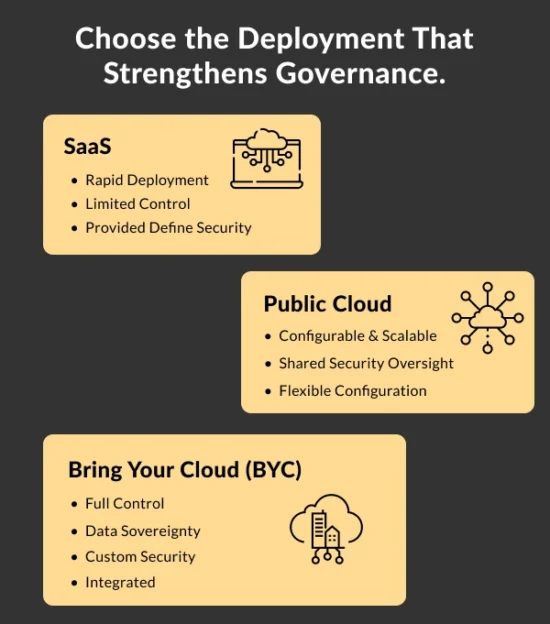
Deployment architecture now shapes enterprise risk as directly as security policy. Data location, access governance, audit visibility, and regulatory alignment depend on where an application runs and who controls the underlying environment. In this context, Bring Your Cloud (BYC) vs SaaS vs public cloud deployment is not simply a technology comparison. It is a decision about ownership, accountability, and operational
Continue Reading BYC vs SaaS vs Public Cloud Deployment: A Strategic Framework for Enterprise Decision Makers