
Reading Time: 7 minutes
I like to think I’m a mid-career law librarian but, if I’m frank, it may be that I’m already at the end of my career based on my position. We have shallow organizational hierarchies and becoming a director is just a couple of hops up the chain from an entry level role. That’s not to say the role acquisition is easy. If I search the AALL member list for “director” and “overall management of the library”, there are only 282 self-described directors. While we are all dealing with bringing in new law librarians, there is also the challenge of where they go once they’re in the profession.
I expect to be working for another 20 years or so and I’ve been in libraries for over 25, hence the mid-career. If I stay a director for that time, whether at my current law library or by lateral move to another, I take up one of those 282 spots. Other law librarians can’t move up from (or lateral from) their leadership roles, and so there are bottlenecks up and down the hierarchy.
I don’t advocate for anyone to get out of the way. I know that’s a sentiment but I think we all make our own choices. Some of us choose to stay on the front lines and some want to work through management. I don’t think you can be entirely self-interested in our profession, which is so heavily focused on service, but there’s undoubtedly personal choice in where we go, what roles we take up, and how long we keep them.
One of the challenges we have, which we didn’t create, is that to increase your compensation you have to move through the hierarchy. I’ve talked about the half-life of legal research skills but skill deterioration is normal when you move through a hierarchy. We move people through the hierarchy in order to compensate them and, by doing so, risk undermining their value to the organization. We take them from where they’ve shown excellence and ask them to do something they’ve probably never trained for and may not have seen good examples of, management. Ideally, we would leave people where they are happiest and most successful and compensate them there.
It’s not that I dwell on my legal research skills but I’m always aware that they’re not as good as my reference librarians, who do the work every day. I can do research in a pinch and I’m actually pretty good in my own knowledge domains but I would flip a question to one of our reference team if it had to do with California law. I know that expertise is gotten through regular practice. My strengths are in operations that tend to be strategic and largely invisible.
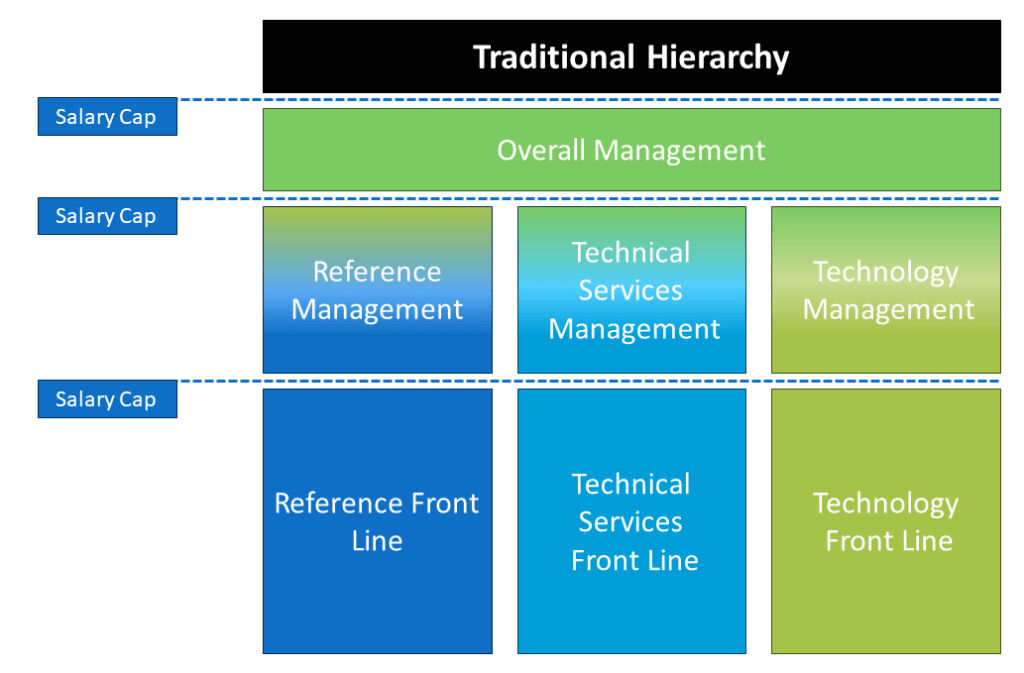
Our middle management layer bridges knowledge domains. They are in a potential transitory role, where they may be mostly delegating their expertise to front line people so that they can grow their supervisory skills. If they are focused on further hierarchical moves, they’ll be focusing on the executive skillsets they’ll need to be a director.
The Money Barrier
I have tried, as a law library director, to be honest about what I know and what I don’t. The reality is that I am not going to run a reference team or a technical services team as well as someone who has more recently moved into that role from a front line role. While I might have deeper management knowledge, I lack the knowledge domain (reference, cataloging) that brings credibility to those roles.
Even if I were to retool and start over by moving back into a knowledge domain in which I’m lower skilled or rusty, I would still choose only one. I could lead a technology team, for example, leaning on my technology background and updating it while using my management knowledge domain at the same time. But I still wouldn’t be competent to also run a reference team as well AND a technical services team as well.
Instead, I have the opportunity to make those people more successful. Frankly, they make it easy. In the past 20 years, I’ve been fortunate to work with really good managers. In most cases, I just have to stay out of their way, especially where it impacts their knowledge domain expertise.
I’m also cognizant that my role is a barrier to their future compensation or career growth within the organization. They may not want either but most roles are banded so that a person’s salary is lower than their supervisor’s. It doesn’t really make any sense unless you believe that hierarchical level equates to value, so the higher the person in the hierarchy, the more valuable they are. I’ve worked in enough organizations to believe that’s not true and I think the Peter Principle wouldn’t exist if it was.
Let’s say you’ve got someone who wants to spend their entire career as a front line librarian. How do you compensate them for that longevity and subject matter expertise if there is a salary cap below management that becomes a ceiling for their compensation? Is the only choice having them move up to be compensated more fairly or to stay where they are, doing what they want to do, for lower compensation?
Move the Leadership from Hierarchy to Knowledge Domain
I’ve been trying to figure out how to get myself out of the way. Our law library Board hired me to run the library. That really breaks down into a couple of areas of knowledge:
- strategy
- running administrative functions (hiring, firing, finances, facilities, governance, compliance, etc.)
- soft management: culture, leadership, communication and other set-by-example functions
There’s really no reason to place any of that at the top of an organization’s hierarchy unless you value command and control. The more I thought about my subject-expertise managers, I realized that I’m more like them than not. It’s just that we are balancing or straddling different knowledge domains.
What if the compensation barrier was moved so that it was a universal cap—what the organization was willing to pay for a given role and expertise—rather than a cap based on your role within the hierarchy, which may ignore your longevity and expertise?
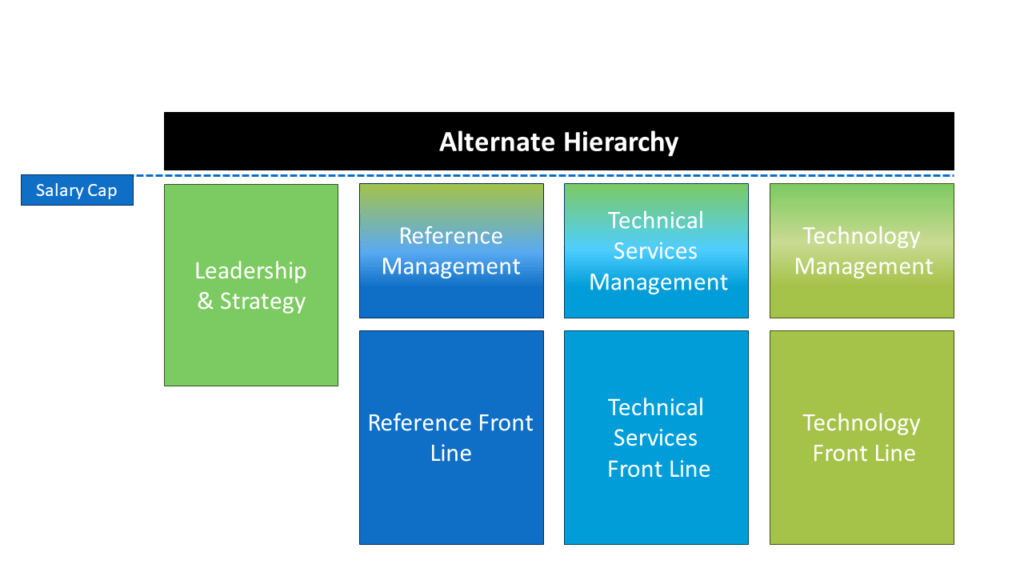
It would mean a couple of significant cultural changes, including that you might have front line staff making more than their director or manager. I accept that that could be uncomfortable in organizations where a person is valued based on salary dollars. But even as I can imagine the discomfort, I can also see the reasonableness of it. As someone who has directed people with greater longevity as librarians and managers, I’m aware that directors are not always paid more due to their experience.
I have been contemplating this for the last year and I am going to ask our Board to take a first step along this road. And perhaps our last. The goal will be to create a broadband salary range (one instead of 3 smaller ranges) for our professional librarians.
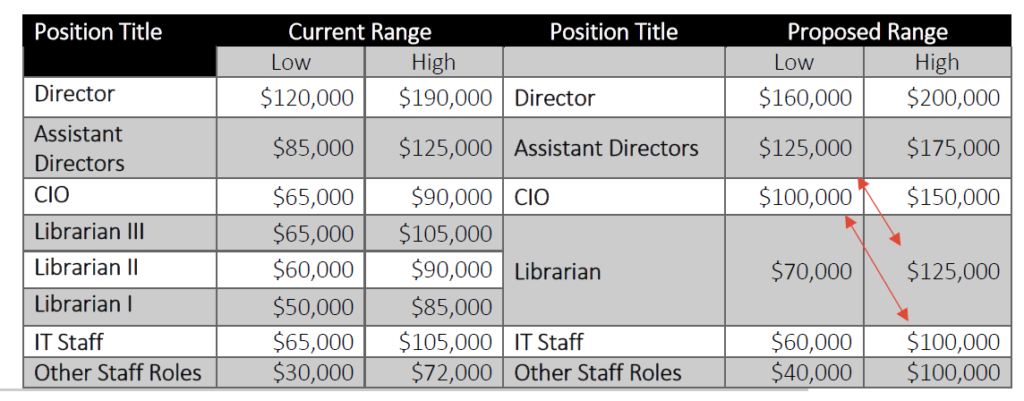
Broadband salary ranges eliminate the step-nature that can force staff to make career changes in order to advance their compensation. They are not better than salary bands that distinguish a Librarian 1 from a Librarian 2. A broadband range can enable inequities—some people may negotiate for higher bumps to move up faster than their peers—that salary setters need to monitor and manage.
I often wonder if we are creating arbitrary and, frankly, unreachable requirements to move through salary bands. If you have a band that requires slightly more project management or slighly more supervisory experience to reach it, what are you doing it for? How do staff know what to do to move up (replicability) or how their colleagues did (transparency)? For the organization or for the person? If the person doesn’t desire more supervisory experience (or if, more likely, you have to create the opportunity because our flat structures mean this opportunity doesn’t exist), why make them jump through that hoop?
If our goal was retention and growth, I think we would rethink our compensation bands. What if we created salary structures that allowed staff to remain for their entire career, eliminating the need to hop (and the need to replace and retrain) to new organizations to grow their compensation? We are seeing that it’s harder to fill our front line roles. We’re seeing Americans move around the country far less than they used to.
I hear the strategic argument: our budget only allows for us to hire 10 people. 6 of those are front line, 3 of them are senior, and 1 is a director. 6 x 1, 3 x 2, and 1 x 3. I get the math.
But it means we are also building in a half-life on our front line staff and managers. I’ve worked at organizations where staff had hit the top of their salary band. It’s a hard cap that they may have to live with, not because it reflects the value they provide the organization, but because the organization doesn’t value their expertise as much as it values their role.
It may mean that management won’t pay as well. Or, as in the chart above, perhaps we think of management as its own knowledge domain and compensate it equivalently rather than as an end-of-career role. I know that’s heretical. And, realistically, impossible unless you’re in a free-standing organization. In other words, not one where everyone else also has to rise through salary bands for compensatory reasons.
I don’t mean to suggest the end of hierarchy either, like Zappo’s holocracy. We need decision-makers. I’m where the buck stops. But the reality is that I take the expert opinion of my managers about what we buy, what we license, what services we deliver and what we charge for them. There is a lateral nature to these decisions (or can be) in a non-directive organization. I can’t argue with a straight face, though, that my expertise or accountability in strategy is more valuable than running a reference team or managing our collection and access to it.
I may just not be a very good director since I don’t see the distinctive value of one. That doesn’t mean I don’t see the role’s distinction. A good director leads the entire organization. They create the culture, they are responsible for the risks (and successes) of the organization, the people who work there are, in a sense, in the director’s care. That accountability, being the endpoint, is a significant and can be a heavy burden. But I’d argue that, like any expertise, it becomes a more bearable burden with time. I’m not sure I think it’s more difficult than running a reference team or managing a technical team once you’ve been doing it awhile.
Either way, I’m pretty confident that we have some unnecessary constraints in our hierarchy-to-compensation structures. I think removing those constraints could allow people to make broader choices about how they wanted to participate in the law librarian profession. I’m less confident about how to get rid of them except within individual organizations, one at a time, and that will require a very particular set of cultural changes.