
The Prudent AI Series: A Field Guide for the Next Era of Enterprise StrategyRecently, I completed a ten-part series on AI strategy and operations on this blog about Prudent AI. It grew out of a simple observation: most corporate conversations about artificial intelligence are trapped in a false binary.On one side, vendor hype insists you must automate everything by Tuesday
Continue Reading The Prudent AI Series
Latest from Dennis Kennedy - Page 2
Specification Sovereignty
Specification SovereigntyWhy You Can Outsource Execution But Never the Definition of SuccessOne of the great attractions of generative AI is that execution keeps getting cheaper. Work that once required scarce professional time can increasingly be delegated to a model, an agent, a vendor, or some combination of all three. That can be a very good thing; I have no attachment
Continue Reading Specification Sovereignty
Direction Over Acceleration
Direction Over AccelerationWhen Execution Becomes Cheap, Strategic Choice Is the Ultimate Competitive AdvantageAI conversations have a natural starting point: What can this technology do?It is an understandable question. Every few weeks, the answer gets larger. Models can write, analyze, code, search, reason, generate images, operate software, and increasingly take autonomous action rather than merely recommend it. Each new capability triggers
Continue Reading Direction Over Acceleration
Pricing the Two Costs of AI Delegation
Pricing the Two Costs of AI DelegationThe Authority You Grant and the Capability You SurrenderIn the adoption of almost every useful technology, there comes a quiet turning point when the fundamental question shifts from whether the system can do the work to whether it should be allowed to do it. Early on, you ask basic capability questions: can the AI
Continue Reading Pricing the Two Costs of AI Delegation
Shadow AI and the Proof Problem
Shadow AI and the Proof ProblemMaking AI Output Look Finished Is Easy. Proving It’s Right Is the Hard Part.There is a familiar, weary conversation happening inside organizations about shadow AI: Which tools are allowed? What data can employees upload? What security controls should IT impose?Those are legitimate governance questions, but they miss the deeper threat. Suppose you solve the shadow
Continue Reading Shadow AI and the Proof Problem
The End of the Standardization Bargain
The End of the Standardization BargainDecoupling Scale from Uniformity in the Age of AIFor most of the last century, sameness was the price of scale: if you wanted to deliver a product or service to thousands of people, you had to standardize it. Litigators didn’t draft custom interrogatories or complaints from scratch for routine disputes. They used master form sets,
Continue Reading The End of the Standardization Bargain
Kill Criteria and Exit Mechanics
Kill Criteria and Exit Mechanics: An Option You Cannot Bring Yourself to Abandon Is Not an Option at AllReal-options reasoning sounds clean in a corporate slide deck, promising a cheap trial where you evaluate evidence before deciding whether to commit real capital. But an experiment only works if its main job is to buy reliable facts, and an option is
Continue Reading Kill Criteria and Exit Mechanics
The Semantic Anchor
The Semantic Anchor: You Can Own All Your Data and Still Lose What It MeansYour organization can own every document, database, and piece of intellectual property it has ever created and still lose something far more difficult to reconstruct: namely, what all of it means. If you need a specific AI model or vendor platform to recover that meaning, you
Continue Reading The Semantic Anchor
The Shortstack Model
The Shortstack Model; Software Architecture as Strategic OptionalityWalk into almost any legal department or enterprise IT steering committee today, and you will find a group of smart people quietly maintaining a museum of recent enthusiasm.Three years ago, as generative models began showing real promise, the immediate institutional instinct was to convene a committee. Procurement teams drafted hundred-page RFPs, enterprise architects
Continue Reading The Shortstack Model
Option, Not Pilots
Options, Not Pilots: The Mechanics of AI Capital AllocationThe AI proposals arrive at your executive committee one at a time. Knowledge Management wants to test an agentic research workflow. The corporate group wants automated first-pass diligence. Business Development has found a tool that promises to identify cross-selling opportunities from the firm’s relationship data. IT wants an enterprise platform rather than
Continue Reading Option, Not Pilots
Flattening the AI Curve
Your goal is to keep AI-driven change from outrunning your capacity to govern, validate, and adapt to it. If you are thinking only about slowing AI down, you are focusing on the wrong problem.During the early weeks of the COVID-19 pandemic in 2020, public health officials introduced a concept that quickly entered the common lexicon: “flattening the curve.” The goal
Continue Reading Flattening the AI Curve
September Issue of Personal Strategy Compass Newsletter is Now Out
The September issue of my Personal Strategy Compass newsletter is now available: “The Defense of the Baseline: Drafting Your Personal Constitution and the Re-Entry Gate.”This issue grew out of something I noticed during a recent major life transition. High-achievers rarely slow down during transitions; they simply shift gears, often into an even higher one. They redirect relentless execution
Continue Reading September Issue of Personal Strategy Compass Newsletter is Now Out
My New Paper: Beyond Hallucinations
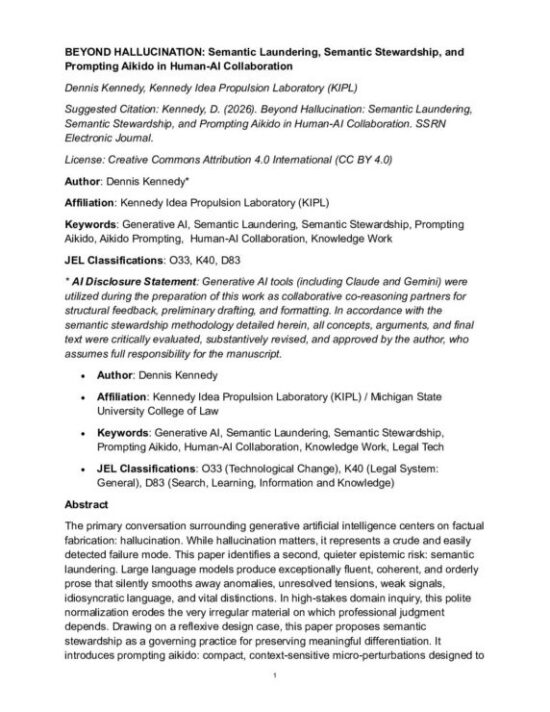
Beyond Hallucination: Semantic Laundering, Semantic Stewardship, and Prompting Aikido in Human-AI CollaborationAbstract:The primary conversation surrounding generative artificial intelligence centers on factual fabrication: hallucination. While hallucination matters, it represents a crude and easily detected failure mode. This paper identifies a second, quieter epistemic risk: semantic laundering. Large language models produce exceptionally fluent, coherent, and orderly prose that silently smooths away anomalies,
Continue Reading My New Paper: Beyond Hallucinations
August Issue of Personal Strategy Compass Newsletter is Now Out
The August issue of my Personal Strategy Compass newsletter is now available: “The Night Watchman: Converting Solitary Anxiety into Strategic Leverage.”This issue grew out of something I started noticing in my own solitary planning blocks. Once I removed the usual operational noise and created some real white space, my analytical mind did not automatically become more strategic. It
Continue Reading August Issue of Personal Strategy Compass Newsletter is Now Out
Twenty Places Claude Went When the Conversation Got Difficult

It started with a routine task, as it usually does. I was using Claude to review a draft critique of an article I had some doubts about, checking the research behind a few of its assertions and testing its logic.During the exchange, I noticed something simple: Claude was applying a strict standard of proof to one person’s claims (the well-known
Continue Reading Twenty Places Claude Went When the Conversation Got Difficult
Another Field Note from an AI #FAIL
People seem to like my AI session transcripts where I see big AI failures. I definitely don’t like living through them, but they can be instructive to readers of this blog.Here’s an excerpt that will give you much to think about. Note my prompting style (my two prompts are in bold) as we reached the end of the session.++++++++++++++++++++Other than
Continue Reading Another Field Note from an AI #FAIL