
Your goal is to keep AI-driven change from outrunning your capacity to govern, validate, and adapt to it. If you are thinking only about slowing AI down, you are focusing on the wrong problem.During the early weeks of the COVID-19 pandemic in 2020, public health officials introduced a concept that quickly entered the common lexicon: “flattening the curve.” The goal
Continue Reading Flattening the AI Curve
Dennis Kennedy Blogs
Latest from Dennis Kennedy
September Issue of Personal Strategy Compass Newsletter is Now Out
The September issue of my Personal Strategy Compass newsletter is now available: “The Defense of the Baseline: Drafting Your Personal Constitution and the Re-Entry Gate.”This issue grew out of something I noticed during a recent major life transition. High-achievers rarely slow down during transitions; they simply shift gears, often into an even higher one. They redirect relentless execution
Continue Reading September Issue of Personal Strategy Compass Newsletter is Now Out
My New Paper: Beyond Hallucinations
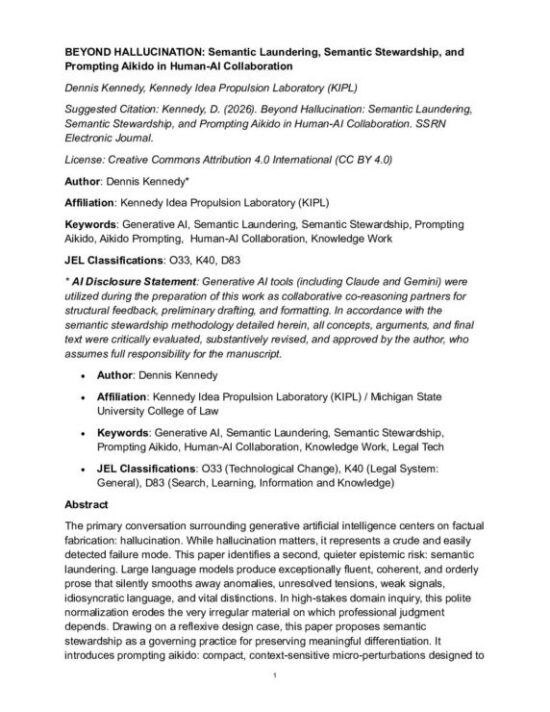
Beyond Hallucination: Semantic Laundering, Semantic Stewardship, and Prompting Aikido in Human-AI CollaborationAbstract:The primary conversation surrounding generative artificial intelligence centers on factual fabrication: hallucination. While hallucination matters, it represents a crude and easily detected failure mode. This paper identifies a second, quieter epistemic risk: semantic laundering. Large language models produce exceptionally fluent, coherent, and orderly prose that silently smooths away anomalies,
Continue Reading My New Paper: Beyond Hallucinations
August Issue of Personal Strategy Compass Newsletter is Now Out

The August issue of my Personal Strategy Compass newsletter is now available: “The Night Watchman: Converting Solitary Anxiety into Strategic Leverage.”This issue grew out of something I started noticing in my own solitary planning blocks. Once I removed the usual operational noise and created some real white space, my analytical mind did not automatically become more strategic. It
Continue Reading August Issue of Personal Strategy Compass Newsletter is Now Out
Twenty Places Claude Went When the Conversation Got Difficult

It started with a routine task, as it usually does. I was using Claude to review a draft critique of an article I had some doubts about, checking the research behind a few of its assertions and testing its logic.During the exchange, I noticed something simple: Claude was applying a strict standard of proof to one person’s claims (the well-known
Continue Reading Twenty Places Claude Went When the Conversation Got Difficult
Another Field Note from an AI #FAIL
People seem to like my AI session transcripts where I see big AI failures. I definitely don’t like living through them, but they can be instructive to readers of this blog.Here’s an excerpt that will give you much to think about. Note my prompting style (my two prompts are in bold) as we reached the end of the session.++++++++++++++++++++Other than
Continue Reading Another Field Note from an AI #FAIL
July Issue of My Personal Strategy Compass Newsletter Published: The Shower Curtain Fallacy
The Shower Curtain Fallacy (And Why You Are Burning Your Vitality)I’ve just published the July issue of the Personal Strategy Compass newsletter, and it centers on a physical metaphor that hit me during my recent Q3 Personal Quarterly Offsite (PQO).I caught myself spending far too much analytical energy on a minor home logistical transition and over-architecting (to put it mildly)
Continue Reading July Issue of My Personal Strategy Compass Newsletter Published: The Shower Curtain Fallacy
The 2026 Associate: Lessons from My Michigan Law Class
In the latest episode of The Kennedy-Mighell Report, Tom Mighell and I turned the spotlight inward to talk about the course I just finished teaching at the University of Michigan Law School called Legal Technology Literacy and Leadership. This course is considered a practical simulation class. It was built this past semester around a specific concept that I call the
Continue Reading The 2026 Associate: Lessons from My Michigan Law Class
June 2026 Issue of Personal Strategy Compass Newsletter is Out

The Halftime Locker Room and the Fallacy of Blind DisciplineWith the 2026 World Cup underway, it is easy to get caught up in the drama of the opening whistle. But any coach will tell you that games are rarely won in the first few minutes. They are won or lost in the locker room during the intermission, when a team
Continue Reading June 2026 Issue of Personal Strategy Compass Newsletter is Out
New Podcast Episode: The Expanding Minefield of Legal AI
The Expanding Minefield of Legal AII’ve been tracking a subtle but dangerous shift in the legal tech landscape. For the last few years, the entire industry has been obsessed with “hallucinations”—obvious, glaring errors like fake case citations. But as Tom Mighell and I discussed on episode 418 of The Kennedy-Mighell Report, focusing strictly on fake cases misses the real
Continue Reading New Podcast Episode: The Expanding Minefield of Legal AI
The Hidden Instruction Problem for Agentic AI and All Other AI
The Door in the Hallway: Agentic AI and the Illusion of Control
We used to talk a lot about the concept of a customized, bounded news feed designed to give professionals exactly what they need to know, and nothing they don’t. It was usually called the “Daily Me.”Lately, I’ve been trying to build a practical, professional-grade version of this workflow
Continue Reading The Hidden Instruction Problem for Agentic AI and All Other AI
The May Issue of Personal Strategy Compass Is Out

The May issue of Personal Strategy Compass newsletter is live, picking up in the silence left behind after April’s “acoustic stage” was cleared of its noise and inherited obligations.If April was about the courage to strip the stage down to its essential signal, May is about the craft required to sustain it.The image that unlocked this issue came from a
Continue Reading The May Issue of Personal Strategy Compass Is Out
The Competence Trap: Anatomy of a Captured Claude #Fail
The prevailing narrative I hear in the legal world is that Claude is the “most human” of the LLMs and, especially, a nuanced, sophisticated writer. When I report that the system has begun to fail my specific research protocols, the common response is a suggestion that I am simply using the wrong version and a disbelief that I am using
Continue Reading The Competence Trap: Anatomy of a Captured Claude #Fail
The April Issue of Personal Strategy Compass Is Out
The April issue of Personal Strategy Compass is out, and this one took longer to find its frame than most.The image that finally unlocked it was Bruce Springsteen’s Tunnel of Love tour. Not the Born in the USA stadium spectacle that preceded it. The moment after, when he stripped the stage down to almost nothing and played to smaller rooms
Continue Reading The April Issue of Personal Strategy Compass Is Out
Liner Notes for My Low Album

When I started posting about AI this year, I did not realize that I was beginning my own version of David Bowie’s Low album.I use that comparison carefully. Low matters here not as a code book or a track-by-track template, but as an allusion to emergence, fracture, atmosphere, and a break in method that only becomes visible after the fact.
Continue Reading Liner Notes for My Low Album